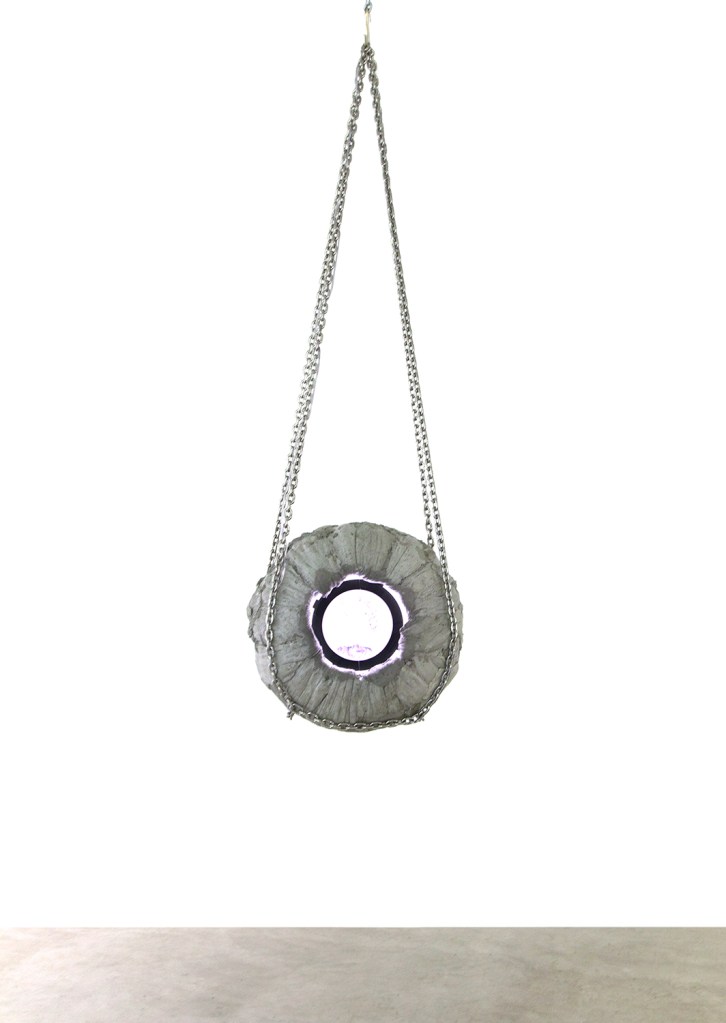
Stainless steel, concrete, chains, light ring, chinese ink and paper
165 x 45 Ø cm
2022
Nearly 400 Chilean lost one of their eyes in the protests of 2019 against neoliberal austerity politics, inherited from the Military dictatorship (1973-1990). The police was deliberately shooting the protesters eyes with rubber bullets in “what’s is known today, in the history of modern ophthalmology, the greatest collective eye mutilation ever registered” (El País Semanal, January 2020).
I was in Chile (researching for another project related to anticolonial wars) and got strongly impressed by the outcome of this violence: the mutilated eye was appropriated as a symbol for the protesters cause.
The mutilated eyes became a model for a collective, gigantic, even monstrous eye. An eye that envisions another frame for social justice. One of the protesters said in an interview: “What we’ve lost and what we’ve given wasn’t for nothing”.
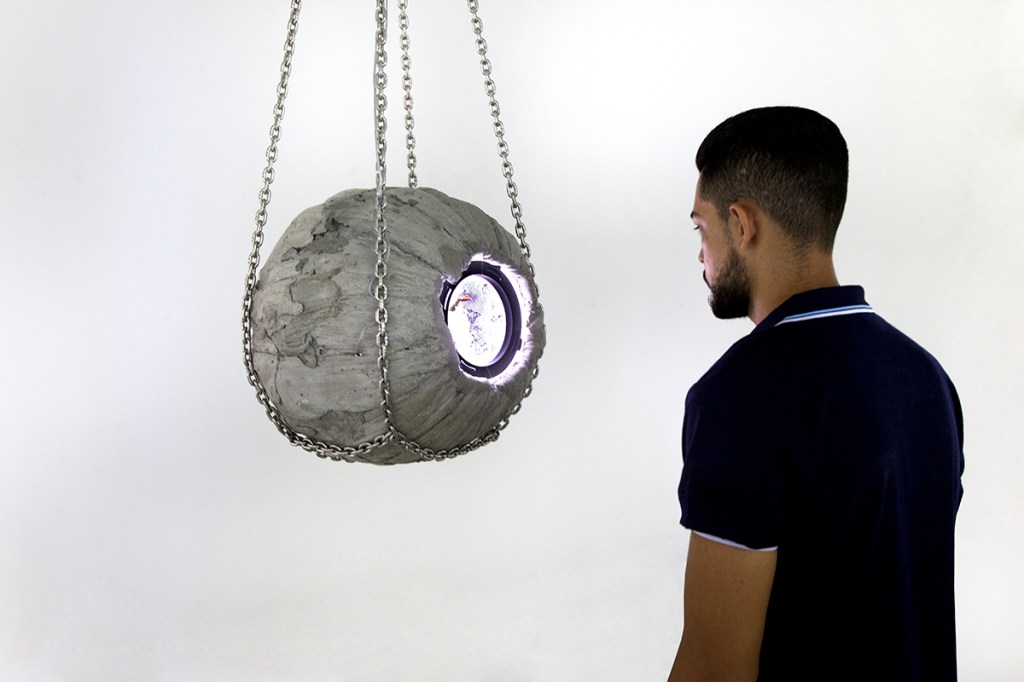

This is a rather visceral way of updating the old notion that “justice is blind”. Conversely, contemporary imaginaries of justice are deeply tied to visual forms – much more than politics of representation would want to admit, as JoanCopjec’s essay “Sour Justice and Liberalist Envy”, a hairy psychoanalytic critique of social justice postulates. Her words resonate with those of the Chilean protester: What if, however, there was a type of symbolization that did not function to represent something, but that made nothing appear? What if the beautiful was not a representation but, in Lacan’s vocabulary, a semblant, an apparent nothing or that which made nothing appear? This raises a further question: why would nothing incite an autonomous or ethical will to action?

 matheus rocha pitta